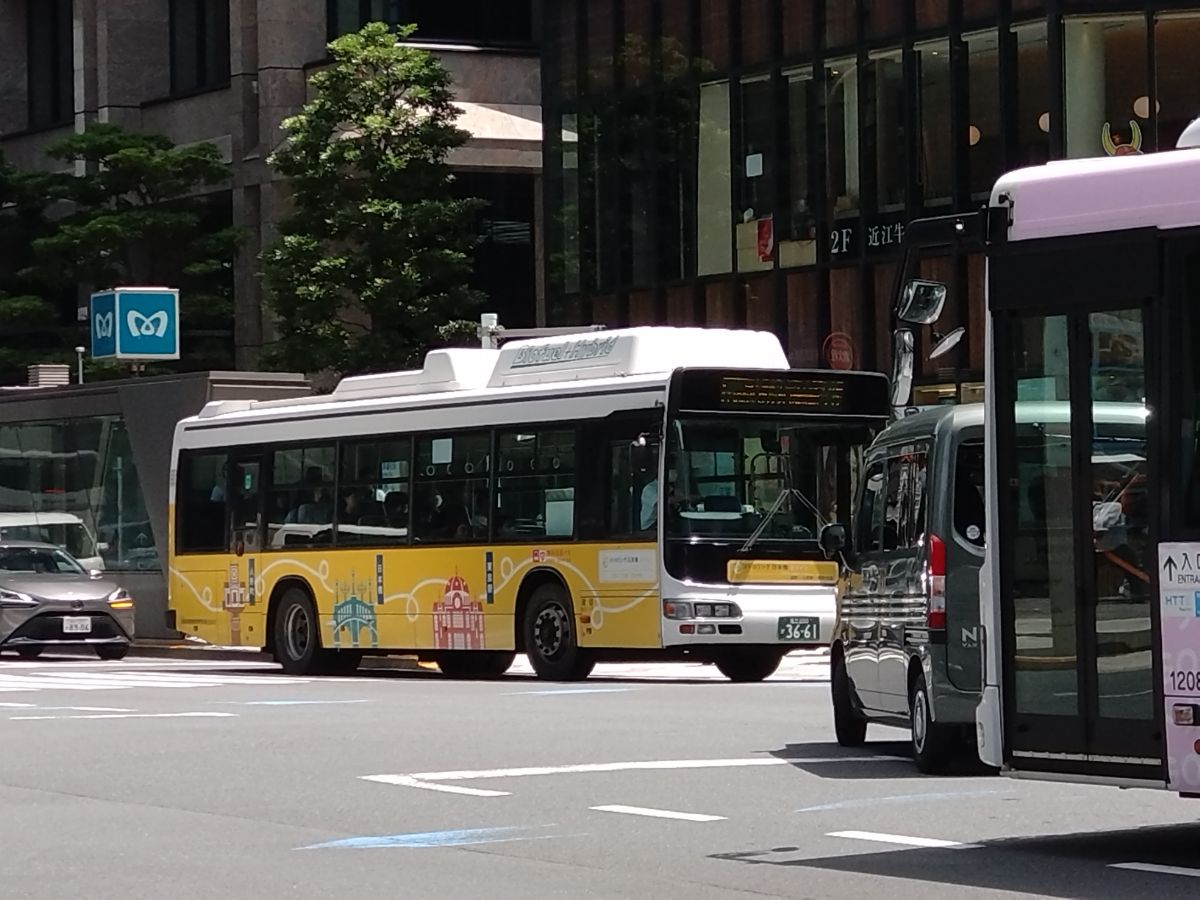
Free circulating buses are very convenient for short-distance travel around Tokyo Station. I often use them when going to Nihonbashi. Several buses run on a regular schedule, so if you wait a little while, one will arrive soon.
There are three routes for the free buses, and each bus has a different color, making them easy to tell apart.
- Marunouchi Shuttle
- Metro Link Nihonbashi
- Metro Link Nihonbashi e-Line
If you wait near the sign that marks the bus stop, a bus will come.
Actually Traveling from Nihonbashi to Tokyo Station
I’m heading from Nihonbashi 2-chome to Tokyo Station.

I got on the free shuttle bus. I’m heading to Tokyo Station Yaesu Exit.

I took this photo after getting off the bus. This is a free shuttle bus, and the word “無料” (free) is written on the side. On the front, “FREE” is clearly displayed in large letters.

This is a Metro Link Nihonbashi Line bus.

Arriving at Tokyo Station Nihombashi Exit
I arrived at the Nihombashi Exit of Tokyo Station. Now that I’m here, I’d like to take a photo of the Marunouchi Shuttle as well. To get to the opposite side of the station, I need to go through the underground passage.

This is Tokyo Station Marunouchi North Exit. I came out from Exit M11.

The free Marunouchi Shuttle bus just passed right in front of me.

Or so I thought—but I ran after it and managed to get a shot from behind.

I’m in front of the Shin-Marunouchi Building. The route looks like the one shown in the image below. There are two routes: one goes from Otemachi Tower to Sumitomo Mitsui Banking Corporation and then returns to the Shin-Marunouchi Building. The longer route makes a wide loop and goes as far as Hibiya.

Marunouchi Shuttle Route
The official map is a bit hard to use, so I entered the route toward Hibiya into Google Maps myself. This is roughly what the route looks like. It gives you an easy way to move around a bit on the west side of Tokyo Station.
Riding the Free Bus Back
I’ve returned to Yaesu North Exit.

Heading Back from Yaesu Exit to Nihonbashi
Here’s the sign to look for.

There are a few people lining up. Even if the sign is hard to spot, it’s easy to find the stop because people are usually waiting there.

Just about to get on the bus. You board from the front and get off from the middle.

I’m back in Nihonbashi.

This is the route of the Metro Link Nihonbashi.

I didn’t ride it this time, but I did take a photo of the bus that runs on the Metro Link Nihonbashi e-Line.

The Metro Link Nihonbashi e-Line goes as far as Hamacho 2-chome and Tokyo City Air Terminal (T-CAT). Compared to the Marunouchi Shuttle, it covers a much wider area. The map below is something I created by entering the route into Google Maps myself. Please note that it does not reflect the actual driving route—it’s just a reference image.
Metro Link Nihonbashi e-Line Route
It felt like being on a school field trip again — I really enjoyed the ride.
Thank you for reading. I hope you enjoyed this little journey!
See how to ride the free shuttle bus to and from TAKANAWA GATEWAY CITY.

